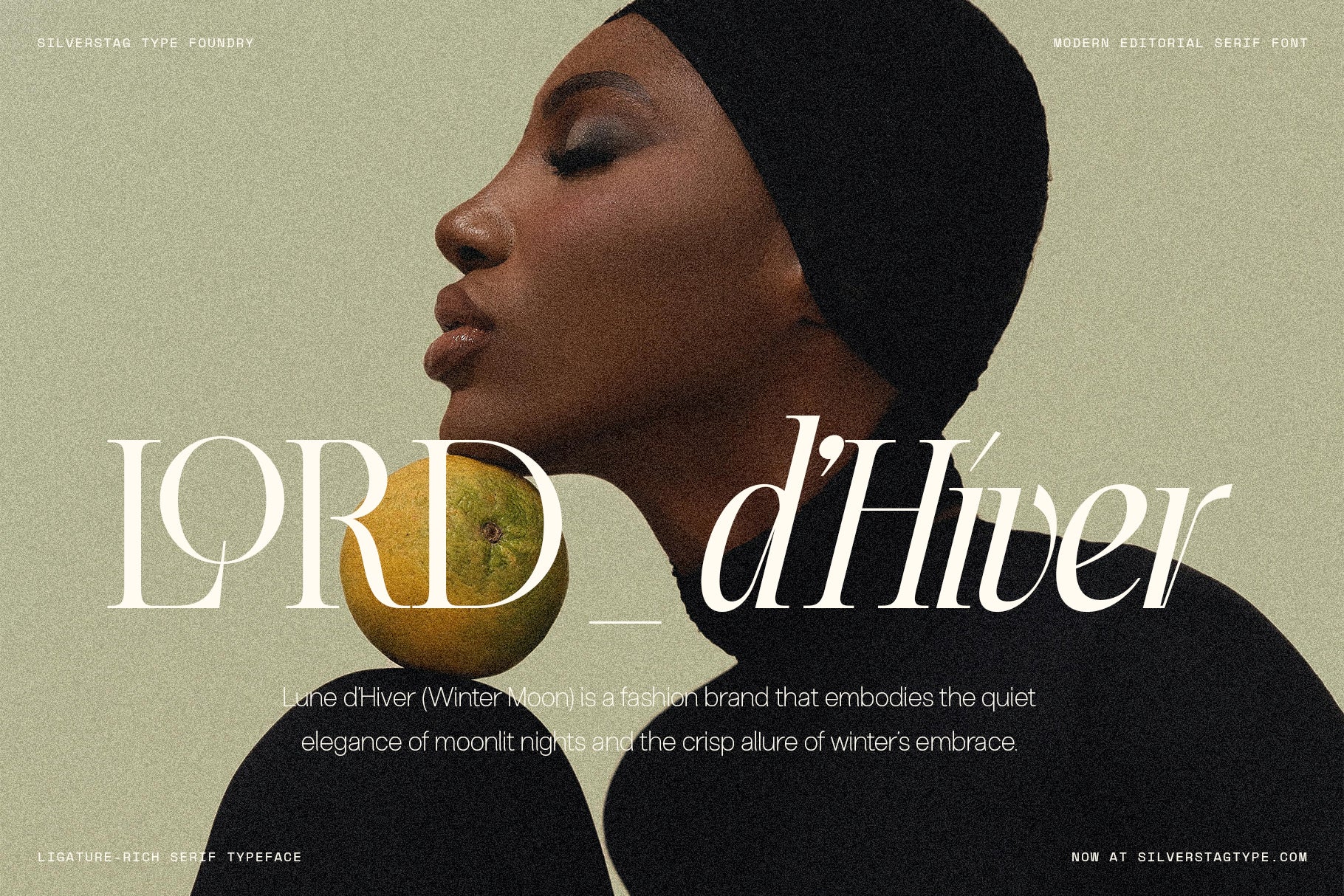
SLTF Netsera is a calligraphic editorial serif drawn across 18 fonts — nine weights from Thin to Black, each with a matching italic, and a character set of more than 900 glyphs with over 170 ligatures and alternates. The hand is in every weight: the movement of...
SLTF Netsera is a calligraphic editorial serif drawn across 18 fonts — nine weights from Thin to Black, each with a matching italic, and a character set of more than 900 glyphs with over 170 ligatures and alternates. The hand is in every weight: the movement of calligraphy carried from the lightest hairline through to the heaviest Black.
The upright weights are composed and high in contrast — the kind of editorial serif that anchors a masthead or holds the cover of a print publication. The italics are where Netsera opens up. Drawn as true italics rather than slanted uprights, they carry swash-quality connections and a genuine calligraphic rhythm. Set the two together and you get typographic tension; let either stand alone and it holds its own.
Then there are the alternates. More than 170 ligatures and stylistic alternates — f-ligatures, swashes, and other connecting forms — drawn so you can decide exactly how expressive the type becomes. Flourish where the word can carry it, hold back where it can't. All of it lives inside the OpenType features, a click away in the software you already use.
Even the figures get the same treatment — teardrop terminals and calligraphic curves that make a date or a price feel drawn rather than typed.
What it's built for:
— Fashion and lifestyle magazine mastheads and editorial layouts
— Luxury brand identities and wordmark design
— High-end packaging, cosmetics, and fragrance labelling
— Wedding stationery, invitations, and event branding
— Book covers and literary publishing
— Hospitality, restaurant, and boutique branding
— Advertising campaigns and editorial headlines
What's included:
— 18 fonts: 9 weights (Thin, Extra Light, Light, Regular, Medium, Semi Bold, Bold, Extra Bold, Black) with 9 matching italics
— Over 900 glyphs
— 170+ ligatures and stylistic alternates
— 100+ language support (Latin Extended)
— OpenType features: liga, dlig, salt, stylistic sets
— Formats: OTF, WOFF, WOFF2
FAQ
What makes Netsera different from other calligraphic serifs?
Most calligraphic serifs arrive as a single display weight. Netsera is a full family — 18 fonts from Thin to Black, upright and italic — with more than 170 ligatures and alternates built in. That range lets it work as a complete typographic system rather than a one-line display face: composed at text and subhead sizes, expressive at display.
Does Netsera work for body text, or is it mainly a display face?
Both, within reason. The lighter upright weights are comfortable for subheadings and short editorial runs. For long-form body text at small sizes, pair Netsera with a neutral serif or sans and let it carry the display and heading work, where the calligraphic detail reads at its best.
What are the 170+ ligatures and alternates for?
They let you tune how expressive the type becomes. Swap in calligraphic alternates, swashes, and ligatures where a word can carry the flourish, and keep it composed where it can't. Everything is accessible through the liga, dlig, salt, and stylistic-set OpenType features in Adobe Illustrator, InDesign, Photoshop, Figma, and the Affinity apps.
What's the difference between the upright and italic weights?
The uprights are composed, high-contrast editorial serifs. The italics are drawn separately as true italics — calligraphic, fluid, with swash-quality connections rather than a mechanical slant. They're built to work together for contrast, or to stand alone with equal conviction.
What software is Netsera compatible with?
Adobe Illustrator, InDesign, Photoshop, Figma, Affinity Designer, Affinity Publisher, Canva Pro, Sketch, and any application that supports OTF or TTF. WOFF and WOFF2 formats are included for web use.
How many languages does Netsera support?
Netsera supports 100+ languages through the Latin Extended character set, including French, Spanish, Italian, German, Portuguese, and more, with full accented and diacritical character support.
Can I use Netsera for commercial projects?
Yes. A standard desktop licence covers most commercial use. For larger teams, web embedding, app use, or broadcast, extended licences are available at silverstagtype.com/pages/enterprise-licensing.
Install and use the font on up to 2 desktop computers for personal or commercial design work. Covers branding, print, packaging, social media graphics, and static digital exports. Each user at your studio needs their own license. Font files may not be shared with clients, collaborators, or third parties.
Full licensing details →Embed the font on websites you own or manage via CSS @font-face for live browser rendering. Covers headlines, UI, and body text on a single web property. Each client website requires its own license. Font files must remain secure and inaccessible to end users or third parties.
Full licensing details →Install and use the font on up to 2 desktop computers and embed it on a single web property via CSS @font-face. Combines the Standard Desktop and Webfont licenses at 25% off buying both separately. Each user at your studio needs their own license, and each client website requires its own. Font files may not be shared with clients or third parties, and web files must remain secure and inaccessible to end users.
Full licensing details →Embed the font in electronic publications including EPUB, MOBI, and PDF formats for personal or commercial distribution. Covers selling or distributing e-books on platforms like Amazon Kindle, Apple Books, or Google Play. Fonts must be securely embedded and not extractable by readers or third parties.
Full licensing details →Embed the font in a single mobile or desktop application for iOS, Android, or similar platforms. Covers UI elements and in-app content. Each unique app project requires its own license. Free and paid versions of the same app count as one. Fonts must be securely compiled and not extractable.
Full licensing details →Embed the font in a single digital product — such as a website template, Canva pack, or social media template — for commercial resale or distribution to unlimited end users. Each product requires its own license. Raw font files may never be included or made accessible to end users.
Full licensing details →✓ Added to your cart — VIEW CART, or keep adding licenses below.
Just me, Alen. I design the fonts, build the website, answer emails, test every file, and pack everything into this little corner of the internet myself. If you reach out, you are talking directly to the person who drew the letters.
Yes. All paid licenses allow commercial use. That includes branding, packaging, posters, social media graphics, YouTube thumbnails, editorial layouts, and pretty much any static design work. If you are not sure, tell me what you are working on and I’ll guide you to the right license.
Here is the simplest breakdown:
If your project mixes several use cases, you might need more than one license. Ask me if you are unsure.
Absolutely. Logo design is fully covered by the Desktop license. You can trademark the logo design you create with my font. You just can’t trademark the entire typeface itself. Convert your final logo to outlines before sending it to your client.
The person or company installing and using the fonts needs the license. If you install the fonts to create work for your client, you need the license. If the client also installs the fonts internally, they need their own license too.
Yes, but with rules:
If your customer edits text, you need the Template or Server License. One license covers one template product. Never include or redistribute the font files.
Usually yes.
If the font only appears in a static logo image on the website, Desktop is enough.
OTF is always the best choice for desktop work and gives you all the OpenType features.
Install OTF. It is the modern format that supports ligatures, alternates, swashes, and smoother curves. Use TTF only if an older machine or tool specifically requires it.
Then restart your design apps so they can refresh their font list.
You need software that supports OpenType features:
If you want, send me a screenshot and I’ll point you to the right panel.
This is usually a cached font list issue. Try this:
This forces your system to rebuild its font list.
Yes, but you need the correct license:
If you are only designing the book cover as an image, Desktop is enough.
You can modify the vector shapes after converting to outlines in Illustrator. You cannot open, rename, reverse engineer, or change the actual font software files. The font file is protected software.
No. Sharing the actual font files outside your licensed team is not allowed.
You can share final artwork. You cannot share the raw font software.
Yes. If your project involves TV, streaming, a very large number of users, or a software platform where many end users interact with the fonts, I can prepare a custom license.
Tell me:
I will review it and send you a tailored offer so everything is covered properly.
Fonts are digital files and cannot be returned once downloaded, so all sales are generally final. But I’m human. If you bought the same font twice or you find a genuine technical issue, email me. I want you to be happy with your purchase.
If you created an account at checkout, log in and re download your fonts anytime. If not, send me your order details and I will email you fresh links.
Just use the contact form on my website or email me directly at info@silverstagtype.com I reply personally. I’m one person, not a support team, so please give me a little bit of time. But I always get back to you.
Every typeface in the SilverStag Type catalog is designed in-house, with a consistent focus on character, versatility, and professional-grade OpenType features. If this one caught your eye, the fonts listed here share the same design language — explore them to find the right fit for your next project.

SilverStag Type Foundry is all about fonts that feel real, intentional, and full of character. Every typeface is crafted with care, with details that come from hours of sketching, refining, and testing in real design projects. These are fonts made for designers who want more than generic type - they want typography with a soul that stands out in branding, editorial, web, and packaging design.
Each font family is inspired by music, stories, and the beautiful chaos of creativity. From bold, expressive display fonts to refined serifs and elegant scripts, every SilverStag typeface is designed to tell a story and bring emotion into your work. If you’re into fonts that break the mold, feel handcrafted, and give your designs a distinctive voice, you’re in the right place.